Professor Xie Lishan and Associate Professor Luo Hao Won the Outstanding Paper Awards of the 2020 China Tourism Research Annual Conference of Tourism Tribune
From November 7th to 8th, the 2020 China Tourism Research Annual Conference of Tourism Tribune was grandly held in Guangzhou. At the annual conference, Professor Xie Lishan and her graduate students won the Outstanding Paper Award of Tourism Tribune in 2019, and Associate Professor Luo Hao and his graduate students won the Outstanding Paper Award of the 2020 China Tourism Research Annual Conference.
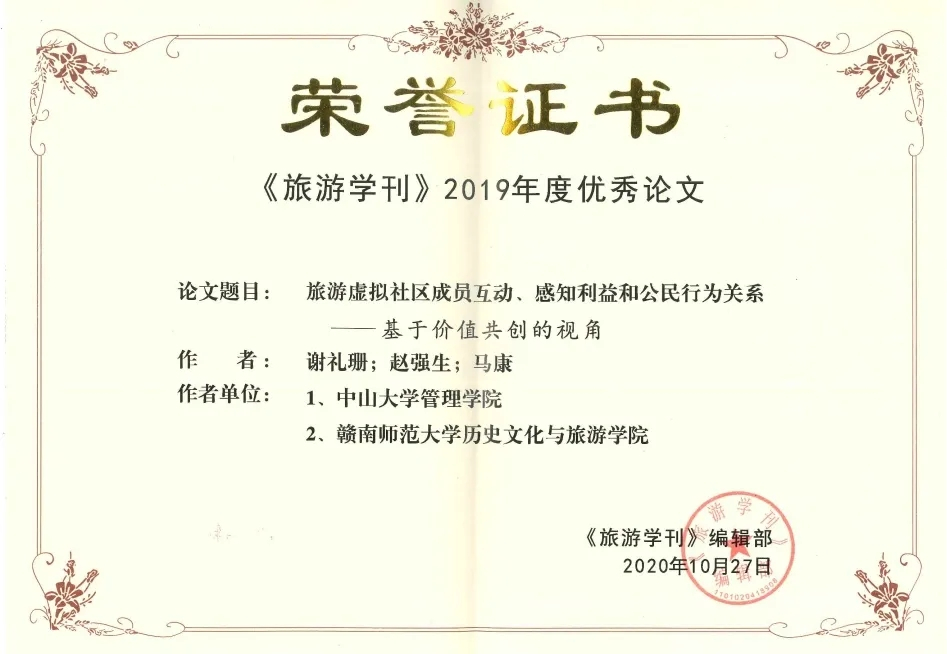
Professor Xie Lishan's award-winning paper "Interactions, Perceived Benefits and Citizenship Behavior Relationships between the Members of Tourism Virtual Communities: Based on the Perspective of Value Co-creation", starting from the key concept interaction of value co-creation, taking the on-line and offline interaction of tourism virtual community members as a starting point for research, using social exchange theory to study the driving force of the citizenship behavior of tourism virtual community members, and testing the online and offline interactions of members in the tourism virtual community, and the relationships between members' perception of value and citizenship behavior. Previous research have mostly observed members' community citizenship behavior from the perspectives of member satisfaction or social identity theory. This research explores how members' interactive experience promotes member value co-creation from the perspective of value co-creation, and clarifies the impact of difference dimensions of community members' perceived value on community citizenship behavior. There are breakthroughs and innovations in theory, and the research results provide a reference for the tourism virtual community to guide community members' positive behaviors for effective management. The full text of the paper was translated into English and published online by CNKI International Publishing Center.

Associate Professor Luo Hao’s paper "Comparative Advantage, Technological Choice and Viability: Evidence from the 'Grass-roots Industry' Hotel Industry" selects the hotel industry in China's provinces as the object from the research scale of the "grass-roots industry", trying to provide a more microscopic empirical test for the core theoretical hypotheses of new structural economics "Comparative Advantage, Technological Choice and Viability". The paper constructs a new indicator "comparative advantage deviation" that reflects "whether technological choice follows comparative advantage" as the core explanatory variable; meanwhile, the average profit rate of star-rated hotels is used to represent the viability, as the explained variable, and the panel regression model is established as the basic model of quantitative analysis. The robustness test of the basic model is tested from three aspects: the replacement of model setting and estimation methods, the replacement of proxy indicators of explained variables, and the replacement of proxy indicators of core explanatory variables. The results of the basic model and various robustness tests consistently reveal that the deviation degree of comparative advantage has a very significant negative impact on the industry's operating performance and viability. Taking the GMM estimation result of the dynamic panel model system as standard, every time the deviation of a region's comparative advantage doubles, the average profit rate of the local hotel industry is expected to drop by 4.5%.