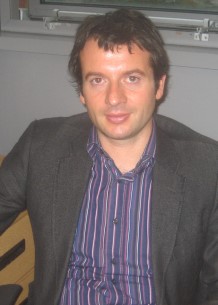
嘉宾简介:
Giovanni Daniele Muzio is Professor of Management at the University of York and an internationally recognised authority on professional and knowledge-intensive occupations and organisations. His research is widely regarded as field-defining, positioning him among the leading global scholars in the study of professions, professional service firms, as well as the governance, ethics, and inequalities associated with expert work.
He has published over 80 research outputs in many of the world’s leading journals across management, organisation studies, sociology, and accounting, including Journal of Management Studies, Organization Studies, Human Relations, British Journal of Management, Accounting, Organizations & Society, and Journal of Economic Geography. He is also the author and editor of major books with Oxford University Press and Cambridge University Press, most notably the Oxford Handbook of Professional Service Firms and Professional Occupations and Organizations. His work has influenced both academic debate and practice and has been featured in outlets such as Harvard Business Review, The Economist, and The Times.
Professor Muzio’s scholarly impact is reflected in an h-index of 45, over 7,700 citations, and repeated inclusion in the Stanford–Elsevier global top 2% of scholars. He has held research funding from the ESRC, European Commission, British Academy, and professional regulators including the Legal Services Board and the Solicitors Regulation Authority.
He has occupied major field-shaping leadership roles, including General Editor of the Journal of Management Studies, Founding Editor of the Journal of Professions and Organization, and Founding Chair of the Organization and Management Editors Network (OMEN). He is currently a member of the UK REF 2029 sub-panel (UoA 17) and has acted as a REF advisor to multiple Russell Group universities.
讲座简介:
This keynote addresses the evolution of the study of professions and professional organizations over the past three decades. It examines how the field’s intellectual agenda, theoretical focus, and methodological approaches have shifted over time. Rather than reflecting a straightforward accumulation of academic knowledge, these changes have been co-shaped by broader transformations in the political economy and concurrent shifts in the mode of academic knowledge production.The presentation will advance a historically sequenced analytical model, illustrating how three relatively stable periods of scholarly formation—the classical professional era, the knowledge economy era, and the networked professional knowledge era—are interrelated with specific political-economic structures (e.g., the welfare state, neoliberal globalization, platform capitalism) and distinct modes of academic production (e.g., monograph-driven, elite journal article-driven, grant-funded project-driven). The analysis will demonstrate how shifts in the external political economy reconfigure the field of professional practice, while changes in the internal academic mode of production—such as journal ecosystems, evaluation regimes, and career pathways—directly shape the core questions, theoretical approaches, and methodological preferences within the study of professions. Building on this framework, the keynote will conclude by deriving a set of strategic principles for academic career development. These principles are designed to offer practical, institutionally grounded guidance for scholars—particularly early-career researchers—on how to navigate, plan, and sustain a meaningful scholarly trajectory within the current “hyper-productive” academic environment, from designing research agendas to articulating theoretical contributions.